If you run a website for textbooks, worksheets or study notes, you probably know the feeling. The pages are useful, students find them, and yet the site sits on page three for the terms that matter. Education is a crowded field, and a small publisher cannot outspend a large platform. What a small publisher can do is spend a modest, steady amount on a few well chosen links. That is the use case this article looks at, using a Vietnamese textlink marketplace as the example, one where buyers purchase textlinks on other people's websites.
I am not going to promise rankings, because nobody honest can. Instead, this is a practical read on what the platform offers, how to think about a small budget, and where the limits are.
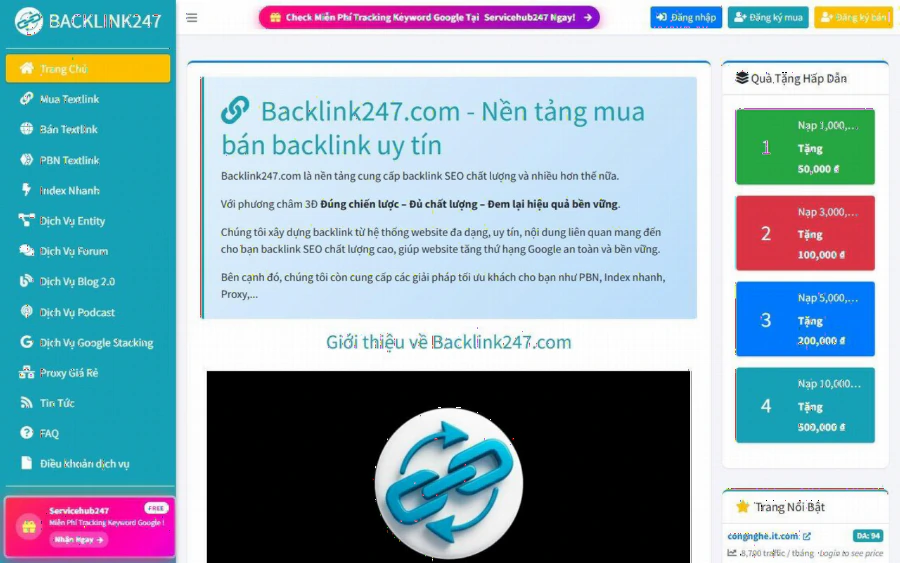
Backlink247 homepage showing the sidebar menu for textlinks, PBN, fast indexing and proxy services, with the top-up bonus panel on the right
What Backlink247 actually is
Backlink247 describes itself as a platform for buying and selling backlinks. On the buyer side, the main product is the textlink: a link placed inside content on a third-party site, either on the homepage or across the whole site. Around that sit extra services listed in the menu: PBN textlinks, fast indexing, Entity services, Forum services, Blog 2.0, Podcast, Google Stacking and proxies.
Two promises stand out on the homepage. The first is "pay only while the link exists", meaning a link that disappears is refunded. The page does not state how long that protection lasts or what conditions apply, so read the terms before you rely on it. The second is that sellers receive payment within 72 hours, which matters if you ever decide to list your own site.
Finding sites that fit a learning project
The buying page is where the platform earns or loses your trust. On the day I looked, the textlink catalogue showed 718 listings, 100 per page. You can filter by domain name, DA and DR ranges, monthly traffic range, website topic, accepted categories, placement type (single page or whole site) and country.
For a textbook or study-materials site, three filters matter most.
- Website topic. A link from an education or reference site is easier to justify to a reader than a link from an unrelated niche. Start with the education category and see how many listings remain.
- Country. If your audience is Vietnamese students, a Vietnamese-language host is more natural than a foreign one.
- Traffic. A site with high DA but almost no visitors can look good in a spreadsheet and do little for you. The catalogue shows monthly traffic next to DA and DR, so compare them side by side. On the featured list on the homepage, for example, several sites show a DA in the 70s but zero monthly traffic, while one shows DA 94 with 8,700 visits a month. Those numbers are the platform's own display, so treat them as a starting point and verify with your own tools.
The listing table also marks whether a site supports automatic link placement ("Tự động đặt link"). If you are placing links yourself, this saves a round of emails with the site owner.
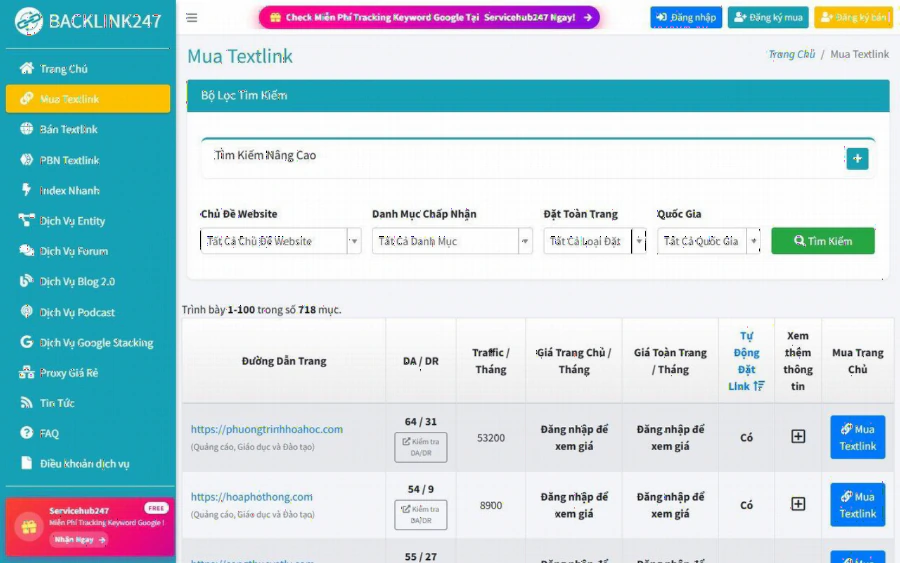
Backlink247 textlink catalogue with filters for topic, category, placement and country, and a table of sites with DA/DR and monthly traffic
The price question, answered honestly
Here is the limitation you should know before you sign up: prices are not public. Every row in the catalogue shows "Login to see price" for both the homepage price and the whole-site price per month. You need a free buyer account to see what a given link costs, which means you cannot build a budget from the outside.
What the site does publish is its top-up bonus table. You add money to your balance and receive a bonus:
| Top-up | Bonus | Bonus as a share (my calculation) |
|---|---|---|
| 1,000,000 VND | 50,000 VND | 5.0% |
| 3,000,000 VND | 100,000 VND | about 3.3% |
| 5,000,000 VND | 200,000 VND | 4.0% |
| 10,000,000 VND | 500,000 VND | 5.0% |
The percentages are my own arithmetic from the published figures. The interesting detail is that the bonus is not a smooth curve. The smallest and the largest top-up both earn 5 percent, while the 3,000,000 tier earns the least. For a small site, the first tier is the sensible entry point: it carries the same percentage as the biggest one and commits you to far less. The homepage also advertises a 50,000 VND voucher for a first order, sent by email after you register.
A sensible way to spend a small budget
Because every link is bought on a monthly basis, the main risk for a small publisher is paying for links that never earn their cost. Here is a cautious routine.
1. Register and read the real prices first. Do not top up until you have seen the cost of the specific sites you want.
2. Shortlist five to ten sites that match your topic and show real traffic, then check each one yourself. Open the site, see whether it looks like something a student would trust, and confirm that outbound links are placed inside real articles.
3. Buy one or two links, not ten. Place them on pages whose subject is close to the page you are linking to, for example a physics worksheet linked from a physics article.
4. Wait and measure. Use your own analytics and Search Console to see whether referral visits and impressions move. A link is an investment you evaluate over weeks, not days.
5. Use indexing only if needed. Backlink247 sells a fast-index service with a stated refund if a URL is not indexed. If a new link is not being discovered, that is one option, but it is not a substitute for a good link.
Strengths and limits
Where it helps. A single marketplace with filters, DA/DR and traffic columns, and the ability to see an order history is simpler than negotiating site by site. The refund-if-lost promise and the 24/7 consulting support the site mentions are useful for a buyer who is new to this. The interface is available in Vietnamese and English, though some banner text is mixed.
Where it does not. Prices are hidden until login, the refund terms are not detailed on the public page, and the catalogue is only as good as the sites on it. A marketplace cannot guarantee that a link will lift a ranking, and search engines treat paid links with caution. If your site covers sensitive subjects such as exam answers or student data, be especially careful about where you place a link. You are responsible for choosing hosts that fit your standards.
Who should consider it. Small education publishers, tutoring blogs and study-materials sites that want a controlled, low-volume way to test paid links.
Who should skip it. Anyone who needs a transparent price list before registering, or anyone hoping a paid link will fix thin content. For that, spend the money on better pages first.
How to get started
Create a buyer account, then browse the textlink catalogue, filter by education and your target country, and note the prices that appear after login. Start with the smallest top-up, buy a single link, and track it for a month before deciding whether to buy more. Used that way, a small budget buys you information as well as links, and information is what a growing learning site needs most.